

Waiting Months for Autism, ADHD, or IEP Support? You Don't Have to Wait for Help
Updated: Feb 28
You're on the waitlist for OAP core funding. The OAP coordinator won't even give you a wait time; you can sit waiting for a Determination of Needs (DON) for months without any answers at all. The school is "working on" the IEP. The intake coordinator said they'll call you in 4-6 months, maybe longer.
Meanwhile, mornings are a battle. Bedtime stretches past 11 PM. Your child is struggling, and you're doing everything you can just to get through the day.
Here's what most families don't realize: you don't have to wait for formal support to start making real progress.
The Reality of Waiting for Autism and ADHD Support in Ontario
If you're navigating the system in York Region or Durham, you already know how long the waits can be. Families waiting for OAP core funding often face timelines of 12-18 months or more. School-based IEP meetings can take weeks to schedule, and implementation of supports can drag on even longer.
And for many parents, the IEP process can feel like a “check box” exercise rather than a meaningful tool. You might be handed the document without feeling truly informed about what it means, what your child is entitled to, or how to make sure it’s actually followed—making it harder to advocate with confidence. Too often, it isn’t treated like a living document that guides day-to-day accommodations and goals. It may not be evaluated, revisited, or updated as frequently as it should be, which means the plan on paper doesn’t always match what your child needs in the classroom right now.
During that time, life doesn't pause. Emotions escalate. Daily routines become harder to maintain. Communication breaks down. And parents are left feeling stuck between "we need help now" and "we're doing everything we're supposed to do."
The weight of waiting isn't just about paperwork, it's about watching your child struggle and feeling like time is slipping away.

What Happens While You're Waiting?
For many families in Stouffville, Markham, and across the York and Durham Regions, the waiting period becomes its own crisis. You might be experiencing:
Escalating behaviours that are becoming harder to manage at home or school. Maybe it's refusal to follow instructions, frequent meltdowns, or aggression when routines change.
Conflict cycles that repeat daily, same triggers, same reactions, same exhaustion for everyone involved.
Skill development on hold. Your child isn't learning the communication, social, or daily living skills they need, and you can feel the gap widening while you wait for "official" services to begin.
Sleep disruptions that affect the entire household, making every day feel like you're starting from behind.
The ticking clock. Even when behaviours are somewhat stable, parents know their child needs to be learning and growing, and every month on a waitlist is a month without progress.
The hardest part? Families are often told to "just wait" without being offered any interim support or practical strategies to use right now.
You Don't Need a Diagnosis to Get Behaviour Support
Here's something important: you don't need to wait for a formal diagnosis or IEP implementation to access behaviour support and parent training.
While the system catches up, your family can start building skills, reducing conflict, and creating calmer routines that work for your child's unique needs.
At White Brick Therapy in Stouffville, we're currently seeing families without a waitlist for ABA-informed therapy and behaviour support. That means you can get help now, not in six months.
What ABA-Informed Therapy Actually Looks Like
If you've heard the term "ABA" and aren't sure what it means in practice, here's the reality: ABA-informed therapy is about understanding behaviour, identifying what's driving it, and teaching practical skills that improve daily life.
It's not about compliance or rigid programs. It's about collaboration.
We work directly with parents to:
Understand the "why" behind challenging behaviours
Reduce conflict cycles by changing how we respond
Build communication skills (including for non-vocal learners)
Create routines that actually stick
Teach emotional regulation strategies your child can use independently
Support sleep, transitions, and daily living skills

Bridging the Gap: Collaborating with OT and SLP Goals
One of the biggest frustrations families face is that occupational therapy (OT) and speech-language pathology (SLP) services are incredibly expensive: often $150-250+ per session. Even with some funding, families can only afford a limited number of appointments.
That's where we come in.
If your child is working with an OT or SLP (or has goals from a previous provider), we can help you integrate those goals into daily life through parent training and behaviour support. Instead of skills staying in the therapist's office for one hour a week, we help you practice and rehearse them at home, during routines, and in real-life situations.
This collaborative approach means:
You're not paying premium rates for practice sessions
Skills generalize faster because they're being used in natural settings
You feel confident implementing strategies on your own
Your child makes progress between "official" therapy appointments
We can also provide ABA service navigation support: helping you understand intensive service providers, funding options, and what questions to ask as you move through the system.
Expertise in Augmentative Communication Systems
For families with non-vocal learners, communication support can't wait. Every day without a functional communication system increases frustration for both the child and the family.
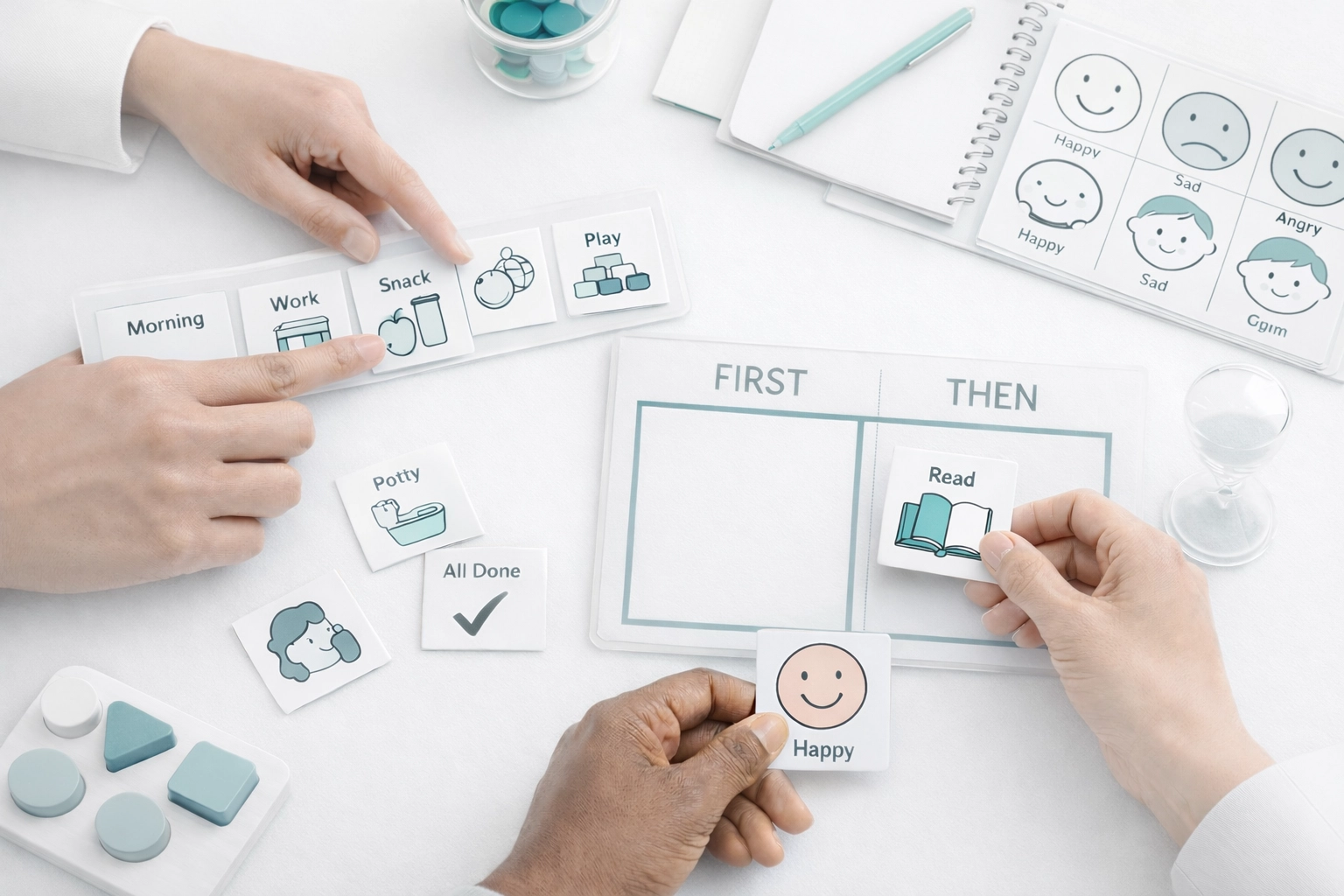
White Brick Therapy has extensive experience in augmentative and alternative communication (AAC) systems, including:
Picture exchange systems
Communication boards and books
Speech-generating devices and apps
Sign language and gesture-based communication
We help families identify which system fits their child's needs and teach everyone in the household how to use it consistently. Communication isn't just about speaking: it's about being understood, making choices, and reducing the frustration that often leads to challenging behaviours.
Social Skills Support for Teens: PEERS Certification
If your teen is struggling with friendships, social cues, or navigating peer relationships, we offer PEERS-certified programming: an evidence-based social skills curriculum designed specifically for teens with autism, ADHD, and social communication challenges.
PEERS focuses on real-world social situations: making friends, handling conflict, joining conversations, and managing social media. It's structured, practical, and taught in a way that teens actually engage with.
Social skill development doesn't have to wait for an IEP to be finalized. Starting now means your teen has more time to practice and build confidence before high school transitions, co-op placements, or post-secondary planning.
What "Behaviour Support" Actually Means (And What It Doesn't)
Let's clear up a common misconception: we do not provide diagnostic assessments. If you're looking for an autism or ADHD diagnosis, you'll need to connect with a psychologist, developmental pediatrician, or specialized clinic.
What we do provide is:
Behaviour support: Identifying triggers, patterns, and effective interventions
Parent training: Teaching you strategies to use immediately in your home
ABA-informed therapy: Evidence-based approaches to skill-building and behaviour change
ABA service navigation: Helping you understand your options and next steps as you wait for intensive services
Our role is to give you tools, support, and a plan while you navigate the larger system. We work alongside your other providers: not instead of them.
Why Families in York Region and Durham Choose White Brick Therapy
Location matters when you're managing appointments, school schedules, and the reality of getting out the door with a child who struggles with transitions. Our Stouffville clinic is accessible for families across Markham, Durham, and York Region.
But beyond location, families choose us because:
There's no waitlist. You can start right away.
We focus on what you can do now, not what might happen in six months.
We collaborate with your existing team (teachers, OTs, SLPs, doctors) to make sure everyone is working toward the same goals.
We respect your family's unique needs and build strategies that actually fit your life.
Ready to Stop Waiting?
If you're tired of being told to wait while your child struggles, it's time to explore what's possible right now.
You can book an intake appointment to discuss your family's specific needs, or learn more about our approach to supporting families in York Region and Durham.
Behaviour support, skill development, and parent training don't require a diagnosis or formal funding to begin. They just require someone willing to meet your family where you are and help you move forward.
Your child's progress doesn't have to be on hold while the system catches up. Let's start now.
White Brick Therapy – Providing psychotherapy services in Stouffville and surrounding areas in the York and Durham Regions.
Virtual therapy Ontario
Online counselling Ontario
Online therapist Ontario
Stouffville therapist
York Region counselling
Teen therapy
Child therapist


Comments