

The Father Who Was There… But Not Really There
Not all wounds come from what was done. Some come from what was missing.
A father doesn’t have to be physically absent to leave an emotional gap. He can be in the home, at the table, even providing and still feel distant, unavailable, or hard to reach.
For a child, especially a daughter, this kind of emotional absence doesn’t always register as trauma in the traditional sense. It registers as a feeling.
A quiet, persistent feeling of: Am I important? Am I seen? Am I enough?
Over time, the child begins to organize herself around those unanswered questions.
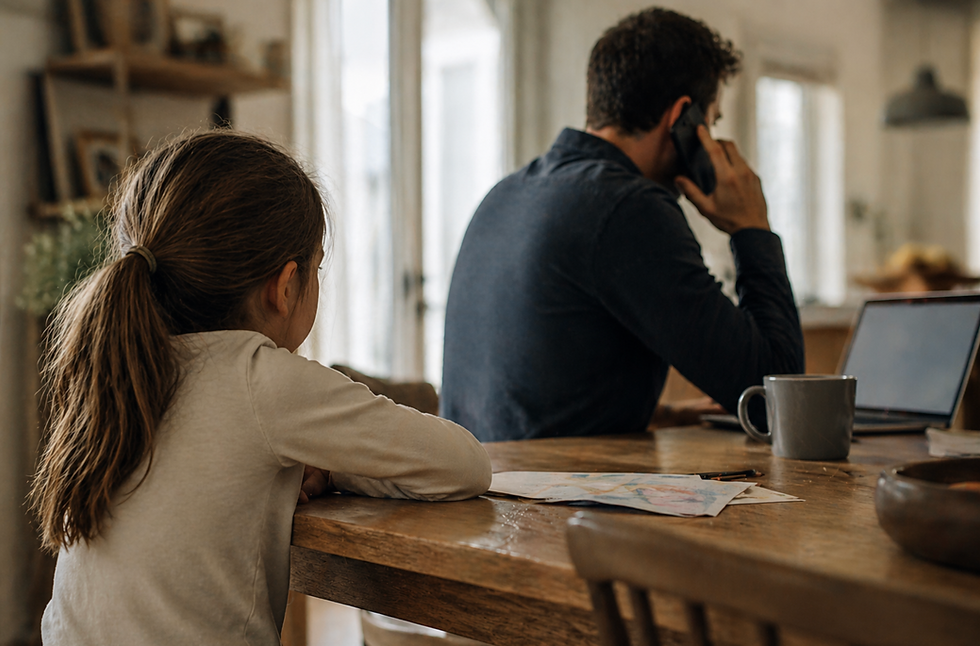
The Child Who Learns to Feel “In the Background”
When a father is emotionally unavailable, inconsistent, or preoccupied whether due to stress, personality, or his own unresolved pain, the child often adapts in subtle but powerful ways.
She may:
Become hyper-aware of others’ moods
Learn to read the room before expressing herself
Feel “too much” or “not enough” at the same time
Begin to equate love with attention, approval, or performance
In some cases, she may even pull back emotionally herself protecting against the pain of wanting connection and not receiving it.
What’s often formed here is not just hurt… but a core belief:
“I am not fully chosen.”
And that belief doesn’t stay in childhood.
How It Shows Up in Adult Relationships
As an adult, this early dynamic often replays, but in more complex, confusing ways.
You might notice:
Feeling small, unworthy, or easily replaced in relationships
A strong emotional reaction to perceived rejection (even subtle moments)
Oscillating between wanting closeness and pulling away
Choosing partners who feel safe… but not fully aligned
Or feeling deeply attached to partners who are inconsistent or emotionally unavailable
Even small moments, like your partner engaging with someone else can trigger something much deeper than the present situation. The reaction isn’t just about what’s happening now.
It’s about what it means.
“I’m not enough.”
This is the nervous system recognizing something familiar, not necessarily something true.
The Link Between Self-Worth and Love
When emotional connection from a parent is inconsistent, children often learn to associate love with effort.
As adults, this can look like:
Seeking validation through relationships
Overgiving, overextending, or people-pleasing
Confusing physical closeness or attention with emotional safety
Feeling responsible for maintaining connection
At its core, there can be a deep longing:
To finally feel chosen, seen, and valued without having to earn it.
The Role of Pain in Shaping Depth
Here’s the part that often gets overlooked.
Pain doesn’t just wound. It shapes.
As Elisabeth Kübler-Ross wrote:
"The most beautiful people we have known are those who have known defeat, known suffering, known struggle and known loss, and have found their way out of the depths.… These persons have an appreciation, a sensitivity and understanding of life that fills them with compassion, gentleness and a deep loving concern. Beautiful people don’t just happen."
Healing Isn’t About Blame. It’s About Awareness
This isn’t about blaming a parent.
Often, emotionally distant fathers were never taught how to be emotionally present. Many carry their own unprocessed pain, limitations, or generational patterns.
But understanding the impact matters.
Because once you can see the pattern, you can begin to change your relationship to it.
What Healing Begins to Look Like
Healing doesn’t mean erasing the past.It means creating new internal experiences.
It looks like:
Recognizing when your reaction is coming from an old wound
Learning to regulate the nervous system in moments of perceived rejection
Separating who you are from what you experienced
Rebuilding a sense of worth that isn’t dependent on others
Allowing yourself to be seen without shrinking
Over time, what once felt automatic begins to shift.
The nervous system learns something new:
I am safe. I am enough.
If you’ve ever felt like you had to earn love, fight for attention, or question your worth in relationships. It may not have started with you.
But healing can!
If you’re ready, we’re here to support you in a way that feels safe, steady, and aligned with you.


Comments